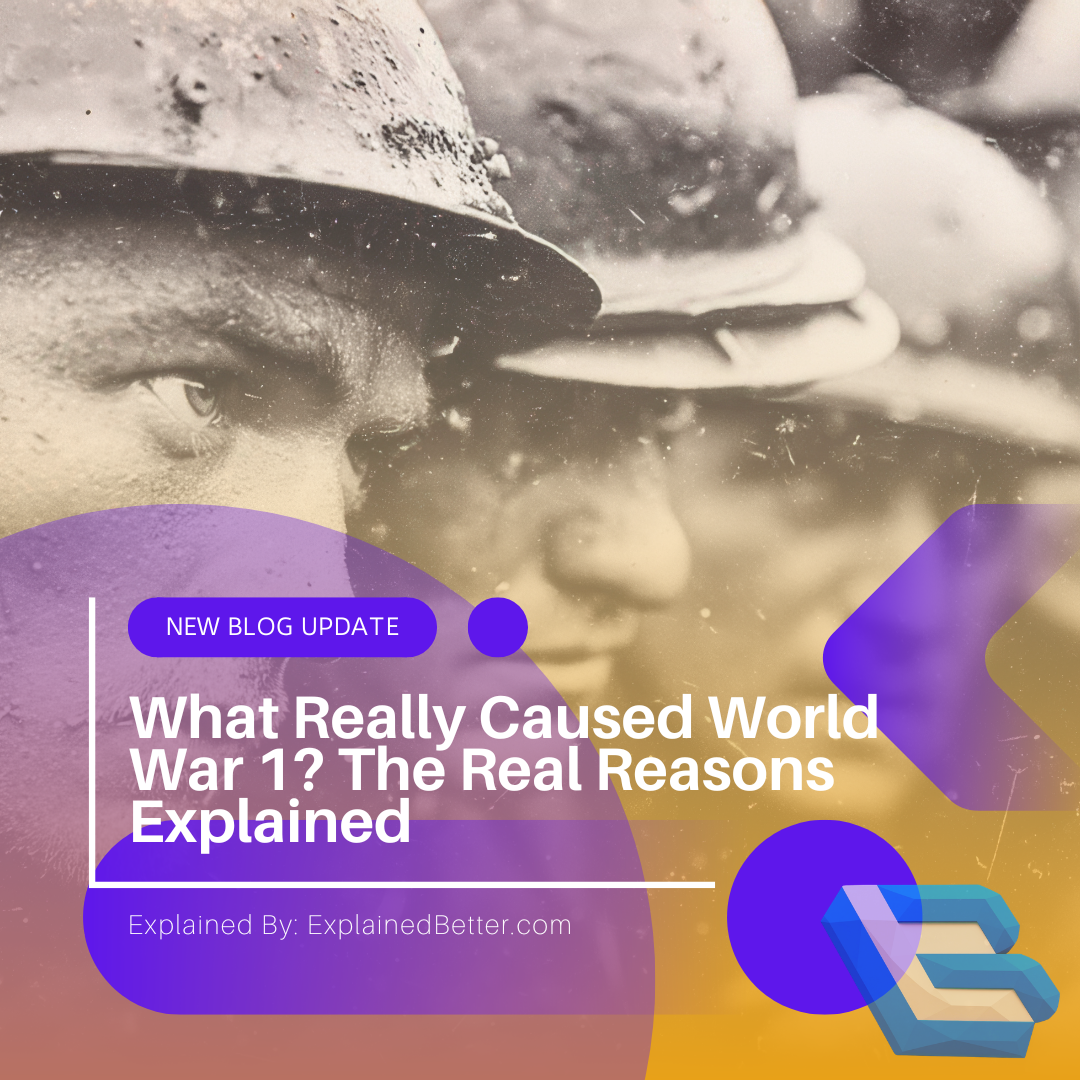

One assassination, and within six weeks Europe’s great powers were at war. But blaming a single gunshot for 20 million deaths misses the point entirely. The bullet was the spark — the continent had been soaked in fuel for decades. Here’s what really caused World War 1.
Key takeaways
- The assassination of Franz Ferdinand triggered the war, but didn’t cause it on its own.
- Four long-term pressures had built up: militarism, alliances, imperialism and nationalism (often shortened to MAIN).
- A web of alliances meant a local dispute dragged in all the major powers.
- Rigid war plans and mobilisation timetables turned a crisis into an unstoppable chain reaction.
The spark: Sarajevo, June 1914
On 28 June 1914, Archduke Franz Ferdinand, heir to the Austro-Hungarian throne, was assassinated in Sarajevo by Gavrilo Princip, a Bosnian Serb nationalist. Austria-Hungary blamed Serbia and issued an ultimatum designed to be rejected.
What followed was the July Crisis — a month of escalating threats. Austria-Hungary declared war on Serbia; the alliance system did the rest, pulling in Russia, Germany, France and Britain in rapid succession. By early August, Europe’s major powers were at war.
But the crucial question is why one political murder in a Balkan city could set the whole continent alight. The answer lies in pressures that had been building for decades.
The four long-term causes (MAIN)
Historians often summarise the underlying causes with the acronym MAIN. It’s a simplification — real history is messier — but it’s a genuinely useful framework.
M — Militarism
Europe had spent decades in an arms race. Military spending had soared, armies had ballooned, and the naval rivalry between Britain and Germany — especially over the fearsome new dreadnought battleships — had poisoned relations. Beyond hardware, there was a mindset: war was widely seen as glorious, even inevitable, and generals held outsized political influence. A heavily armed continent that half-expected war was primed to have one.
A — Alliances
The powers had bound themselves into two opposing blocs. On one side, the Triple Alliance of Germany, Austria-Hungary and Italy; on the other, the Triple Entente of France, Russia and Britain. These pacts were meant to deter war by balancing power. Instead they acted as tripwires — a conflict between any two members threatened to drag in everyone. A dispute between Austria-Hungary and Serbia became, through these commitments, a continental war.
I — Imperialism
The great powers competed fiercely for colonies and global influence. This rivalry generated repeated crises — clashes over Morocco and tensions in the Balkans among them — that hardened hostilities and built a habit of brinkmanship. Each crisis that was survived left less trust and more resentment for the next.
N — Nationalism
Intense national pride made populations eager to prove their nation’s superiority and quick to take offence. In the Balkans it was especially explosive: Slavic nationalism sought independence from Austro-Hungarian rule, and Serbia’s ambitions directly threatened the empire. The region was so volatile it was called the “powder keg of Europe” — and Sarajevo was where it detonated.
The trigger mechanism: mobilisation timetables
One underappreciated cause turned a crisis into a catastrophe: the rigidity of military plans.
The powers had drawn up detailed mobilisation schedules — precise timetables for moving millions of troops by railway. Germany’s Schlieffen Plan, for instance, assumed a two-front war and depended on defeating France extremely fast, before Russia could fully mobilise, which meant marching through neutral Belgium.
These plans created a terrible logic. Once one country began mobilising, its rivals felt compelled to mobilise immediately or risk being caught unprepared. Mobilisation was hard to pause or reverse without wrecking the whole schedule. Leaders found themselves trapped by their own timetables, feeling they had to act within days or lose any advantage. Diplomacy simply ran out of time.
Could it have been avoided?
This remains one of history’s great debates, and honesty requires acknowledging it’s unresolved.
Some historians argue the war was practically inevitable given the pressures that had built up — the tinder was so dry that some spark would eventually have caught. Others contend it was the product of specific, avoidable choices during the July Crisis, and that different decisions by a handful of leaders could have contained the conflict to the Balkans.
The most defensible summary is that the long-term causes made a major war likely, while the short-term decisions of July 1914 made this war happen when and how it did. Both layers matter, and reducing it to either the assassination alone or impersonal forces alone gets the history wrong.
The terms, explained
- July Crisis
- The month of diplomatic escalation after the assassination that led directly to war.
- MAIN
- Militarism, Alliances, Imperialism, Nationalism — the standard shorthand for the long-term causes.
- Triple Alliance / Triple Entente
- The two opposing alliance blocs whose commitments turned a local dispute into a continental war.
- Schlieffen Plan
- Germany’s rigid war plan for rapidly defeating France before turning to Russia, which required invading neutral Belgium.
- Mobilisation
- Assembling and deploying a nation’s armed forces for war — governed by strict railway timetables that were hard to halt.
- Balkans
- The southeastern European region of intense national and imperial rivalry, dubbed the “powder keg of Europe.”
- Dreadnought
- A revolutionary class of battleship at the centre of the Anglo-German naval arms race.
History lands differently with maps and timelines in front of you — see our History video explainers for the visual version.
Frequently asked questions
Did the assassination of Franz Ferdinand cause World War 1?
It triggered it, but didn’t cause it alone. The assassination lit a fuse on decades of accumulated tension — militarism, rival alliances, imperial competition and nationalism. Without those, the murder would likely have stayed a local crisis.
What does MAIN stand for?
Militarism, Alliances, Imperialism and Nationalism — the four long-term causes commonly used to summarise the pressures behind the war. It’s a helpful framework, though historians debate the relative weight of each.
Why did so many countries get involved so quickly?
The alliance system. Interlocking commitments meant a war between Austria-Hungary and Serbia obligated their allies to join, chaining the major powers together. Rigid mobilisation timetables then made stopping almost impossible.
Was World War 1 inevitable?
Historians disagree. Some see it as nearly unavoidable given the built-up tensions; others argue different choices in July 1914 could have prevented it. A fair summary: the conditions made a major war likely, but the specific decisions of 1914 shaped how and when it came.
Sources & further reading
- Imperial War Museums — What was the First World War?
- Britannica — The outbreak of World War I
- BBC History — World War One