
Whenever inflation rises or the economy wobbles, one institution dominates the headlines: “the Fed.” It’s blamed and credited for almost everything, yet few people can say what it actually is or does. Here’s a clear, neutral explanation of the Federal Reserve — America’s central bank — and the powerful, blunt tool at its disposal.
Key takeaways
- The Federal Reserve is the central bank of the United States — the “bank for banks” and the government.
- Its two main goals are stable prices (low inflation) and maximum employment.
- Its main tool is setting a key interest rate, which ripples through the whole economy.
- It’s designed to be independent of day-to-day politics, which is itself debated.
What the Federal Reserve is
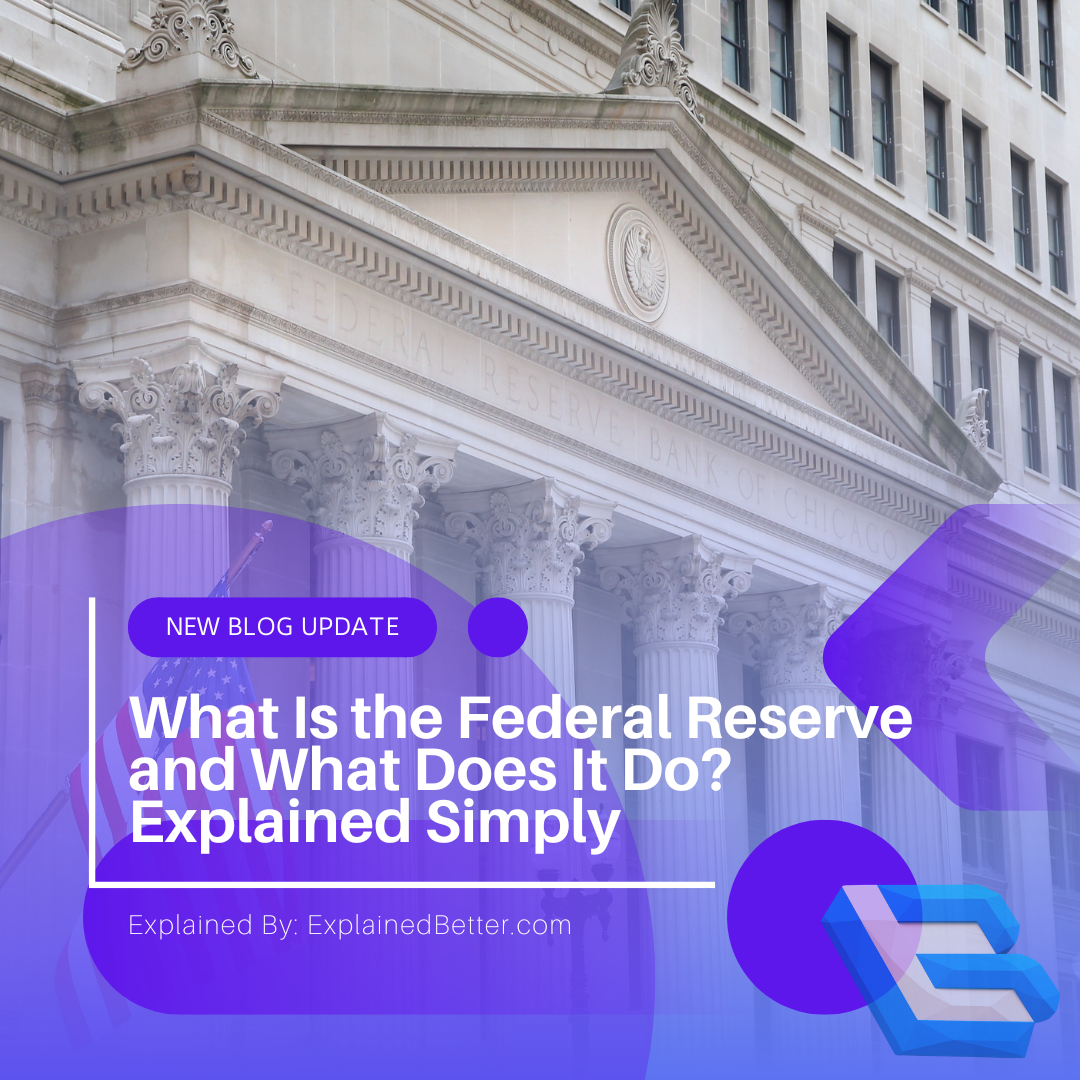
The Federal Reserve — “the Fed” — is the central bank of the United States. Ordinary banks serve people and businesses; a central bank sits a level above, serving the banks themselves and the government, and overseeing the whole financial system.
Created by Congress in 1913, it was set up in response to a history of banking panics, with the goal of giving the country a safer, more stable financial system. It’s a somewhat unusual hybrid — a public institution created by government, but with a structure that deliberately keeps its decisions insulated from short-term political control.
The Fed’s main jobs
The Fed has several responsibilities, but two goals sit at the centre — its so-called “dual mandate.”
- Stable pricesKeeping inflation low and predictable. The Fed targets around 2% inflation over the long run — enough to avoid the dangers of falling prices, without eroding people’s money too quickly.
- Maximum employmentSupporting conditions in which as many people who want jobs can find them. A healthy economy with low unemployment is the second half of the mandate.
- Keeping the financial system stableActing as a “lender of last resort” during crises — stepping in when the banking system is under severe stress to prevent a collapse from spreading.
- Supervising banks and running the plumbingRegulating and monitoring banks, and operating core financial infrastructure like the systems that move money between banks and process payments.
The big lever: interest rates
The Fed’s most powerful and closely watched tool is setting a key interest rate — the rate that influences how expensive it is to borrow money throughout the economy. When the news reports “the Fed raised (or cut) rates,” this is what it means.
The logic is a balancing act between its two goals.
- To fight high inflation, the Fed raises rates. Borrowing becomes more expensive, so people and businesses spend and borrow less. Cooler demand eases the upward pressure on prices — but it also slows the economy, and can raise unemployment.
- To support a weak economy, the Fed cuts rates. Borrowing becomes cheaper, encouraging spending, investment and hiring. That boosts growth — but push too far and it can fuel inflation.
Because these two aims can pull in opposite directions, the Fed is constantly trying to strike a balance — cooling inflation without triggering a recession, a difficult target often described as a “soft landing.”
How decisions get made
Rate decisions are made by a committee — the Federal Open Market Committee (FOMC) — which meets several times a year. Officials review data on inflation, jobs and growth, then vote on whether to raise, cut or hold rates. These meetings and the statements that follow are among the most scrutinised events in global finance, because the outcome affects markets and borrowers worldwide.
Why its independence is debated
The Fed is deliberately structured to be independent of day-to-day politics. The reasoning: interest-rate decisions sometimes require unpopular moves — like raising rates to curb inflation, which slows the economy — that elected officials facing the next election might avoid. Insulating the Fed is meant to let it make hard, long-term choices.
But that independence is genuinely contested. Supporters argue it keeps monetary policy credible and free from political pressure, which helps control inflation. Critics argue that so much power over the economy shouldn’t rest with unelected officials, and that the Fed should be more accountable to the public. This is a long-running debate with reasonable arguments on both sides — and it isn’t the place of an explainer to settle it.
The terms, explained
- Central bank
- An institution that manages a nation’s money and monetary policy and oversees its banking system. The Fed is the US central bank.
- Dual mandate
- The Fed’s two core goals set by Congress: stable prices and maximum employment.
- Interest rate (policy rate)
- The key rate the Fed sets, which influences borrowing costs across the economy.
- Monetary policy
- Actions a central bank takes to influence money, credit and interest rates — distinct from government tax-and-spending (fiscal) policy.
- FOMC
- The Federal Open Market Committee — the group within the Fed that decides interest-rate policy.
- Lender of last resort
- The Fed’s role providing emergency funds to the banking system during a crisis to prevent collapse.
- Soft landing
- Slowing the economy just enough to reduce inflation without causing a recession — a difficult balance.
For the charts and numbers behind these terms, our News video explainers cover the economy in the same neutral, plain-English style.
Frequently asked questions
What does the Federal Reserve actually do?
It’s the US central bank. Its main jobs are keeping inflation low and stable, supporting maximum employment, keeping the financial system stable, and supervising banks. Its most visible tool is setting a key interest rate that influences borrowing across the economy.
Why does the Fed raise or cut interest rates?
To balance its two goals. It raises rates to cool high inflation by making borrowing more expensive, and cuts rates to support a weak economy by making borrowing cheaper. The tricky part is doing so without either overheating the economy or causing a recession.
Is the Federal Reserve part of the government?
It’s a public institution created by Congress, but deliberately structured to be independent in its day-to-day policy decisions. This mix — accountable to government yet insulated from short-term politics — is intentional, and its independence is genuinely debated.
How does the Fed affect my money?
Its rate decisions feed through to the interest on mortgages, loans, credit cards and savings. Higher rates make borrowing costlier but can boost savings returns; lower rates do the opposite. The effects often take months to fully appear.
Sources & further reading
- Federal Reserve — About the Fed
- Federal Reserve — What is the purpose of the Fed?
- Britannica — Federal Reserve System