
In 79 AD, a thriving Roman city was buried under metres of volcanic debris in a single day — and then almost perfectly preserved for nearly 1,700 years. Pompeii is the closest thing we have to a snapshot of everyday Roman life frozen mid-moment. Here’s what actually happened, and why the disaster left us such an extraordinary record.
Key takeaways
- Pompeii was destroyed when nearby Mount Vesuvius erupted, most likely in 79 AD.
- Most victims were killed not by lava but by surges of superheated gas and ash.
- The city was buried and preserved almost intact, sealing daily Roman life in place.
- The famous body “casts” were made by pouring plaster into voids left by decayed victims.
The city before the disaster
Pompeii was a prosperous Roman town near the Bay of Naples, home to perhaps 10,000–20,000 people. It had streets, shops, bakeries, public baths, an amphitheatre, grand villas and humble homes — a completely ordinary, bustling Roman city.
It sat in the shadow of Mount Vesuvius, whose fertile volcanic soil made the region rich for farming. Crucially, the Romans didn’t recognise Vesuvius as an active volcano; it had been dormant so long that its true nature was forgotten. The people of Pompeii were living beside a threat they didn’t know existed.
What actually happened during the eruption
Our best account comes from a remarkable eyewitness. Pliny the Younger, a Roman writer watching from across the bay, described the catastrophe in letters — the reason a certain violent eruption type is now called “Plinian.” The disaster unfolded in two devastating phases.
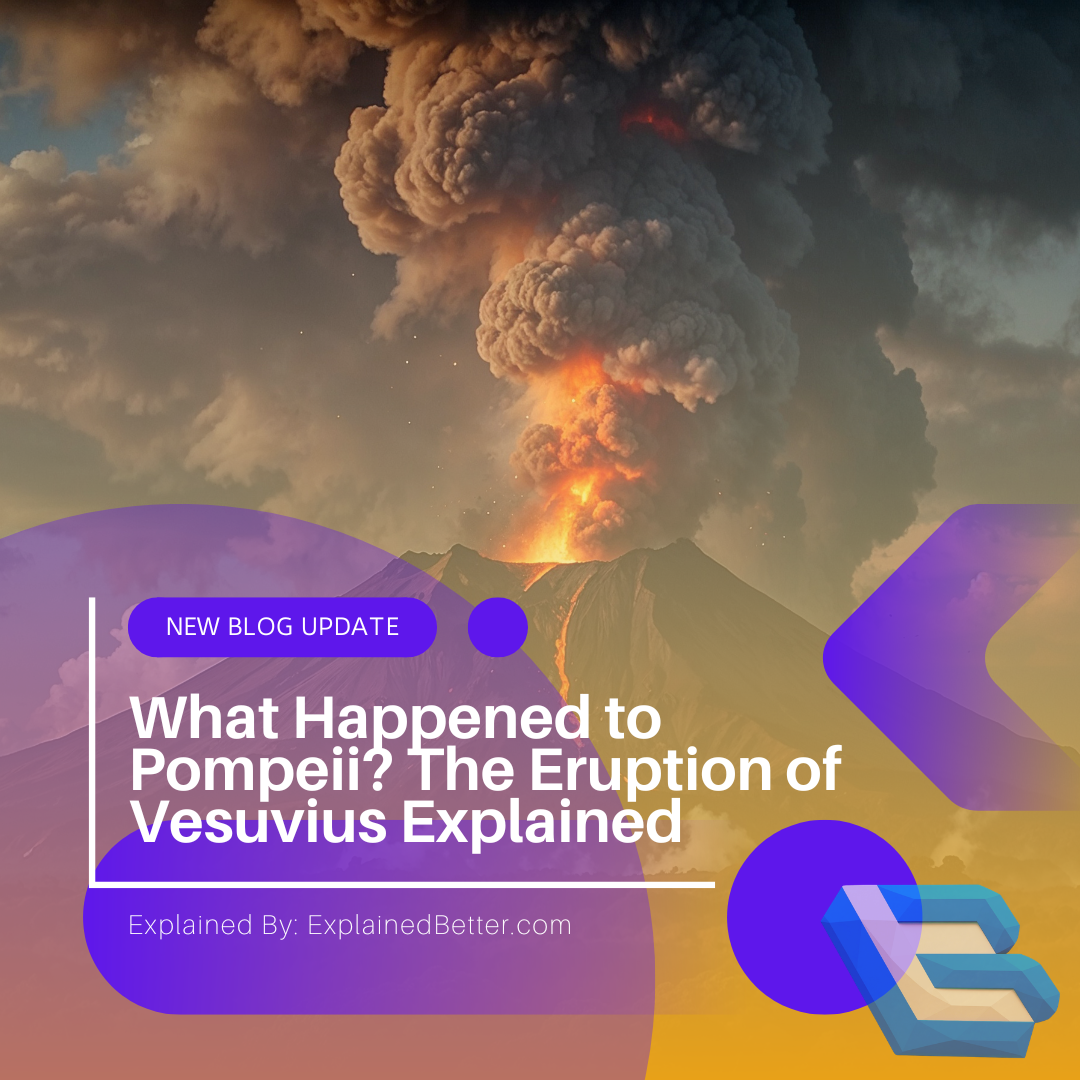
- The eruption columnVesuvius blasted a colossal column of ash, pumice and gas kilometres into the sky. Pliny compared its shape to an umbrella pine tree. This debris began raining down on Pompeii, accumulating on roofs and streets and causing many buildings to collapse under the weight.
- The ashfall traps the cityOver hours, pumice and ash piled up metres deep. Some residents fled early; others sheltered indoors hoping to wait it out — a decision that would prove fatal as the second phase arrived.
- The pyroclastic surgesThe eruption column eventually collapsed, sending pyroclastic flows — avalanches of superheated gas and volcanic matter — racing down the mountain at high speed. These surges, not lava, killed most of the people who remained.
- Total burialBy the time it ended, Pompeii lay under several metres of volcanic material, sealed away and hidden from the world.
Why it was so perfectly preserved
Here’s the paradox at the heart of Pompeii: the disaster that destroyed it also protected it. The deep blanket of ash and pumice sealed everything from air and moisture, the two things that normally rot and erode the past.
Buildings kept their walls and roofs. Vivid wall paintings and mosaics stayed bright. Loaves of bread sat in ovens, election notices remained painted on walls, and the contents of shops and homes stayed where they were dropped. When excavations later uncovered the city, archaeologists found not ruins so much as a town paused mid-life — an unmatched window into ordinary Roman existence, from food and furniture to graffiti and daily routines.
The haunting body casts
The most famous images of Pompeii are the body “casts,” and how they were made is both clever and poignant. As victims were buried in ash, their bodies were encased. Over centuries the soft tissue decayed, leaving hollow, body-shaped voids in the hardened volcanic material, with the skeletons inside.
In the 19th century, an archaeologist realised these cavities could be filled. By pouring liquid plaster into the voids and letting it set, then chipping away the surrounding rock, he recreated the exact shape of the victims in their final moments — capturing postures, clothing folds, and expressions with startling detail. They’re not the bodies themselves but precise casts of the space the bodies left behind.
A note on the date
For centuries the eruption was dated to 24 August 79 AD, based on a copy of Pliny’s account. But evidence at the site — autumn fruits, heavier clothing, and an inscription — has led many scholars to favour an October or November date instead. It’s a good example of how history gets refined: even a “known” fact can shift as new evidence emerges.
The terms, explained
- Vesuvius
- The volcano near Naples whose 79 AD eruption buried Pompeii. It remains active today.
- Pyroclastic flow / surge
- A fast-moving avalanche of superheated gas, ash and rock — the main cause of death at Pompeii.
- Plinian eruption
- A violent eruption type producing a tall column of ash and gas, named after Pliny the Younger’s description.
- Pumice
- Light, porous volcanic rock that rained down on Pompeii and helped bury it.
- Pliny the Younger
- The Roman writer whose letters give the only detailed eyewitness account of the eruption.
- Herculaneum
- A nearby town also destroyed by the same eruption, preserved differently and equally important to archaeologists.
History lands differently with maps and images in front of you — see our History video explainers for the visual version.
Frequently asked questions
What destroyed Pompeii?
The eruption of Mount Vesuvius, most likely in 79 AD. The city was buried under metres of ash and pumice, and most victims were killed by pyroclastic surges — waves of superheated gas — rather than by lava.
Did lava kill the people of Pompeii?
No. The main killers were pyroclastic surges: avalanches of gas hot enough to cause near-instant death. Slow-moving lava played little role, which is part of why the city was preserved rather than melted.
How was Pompeii so well preserved?
The deep volcanic burial sealed the city from air and moisture, preventing the decay and erosion that normally destroy the past. Buildings, paintings, food and everyday objects were kept almost intact for nearly 1,700 years.
Are the body casts real bodies?
Not exactly. As victims decayed, they left body-shaped hollows in the hardened ash. Archaeologists poured plaster into these voids to recreate the shapes — so the casts capture the exact form and posture, with the skeleton inside, but aren’t the preserved bodies themselves.