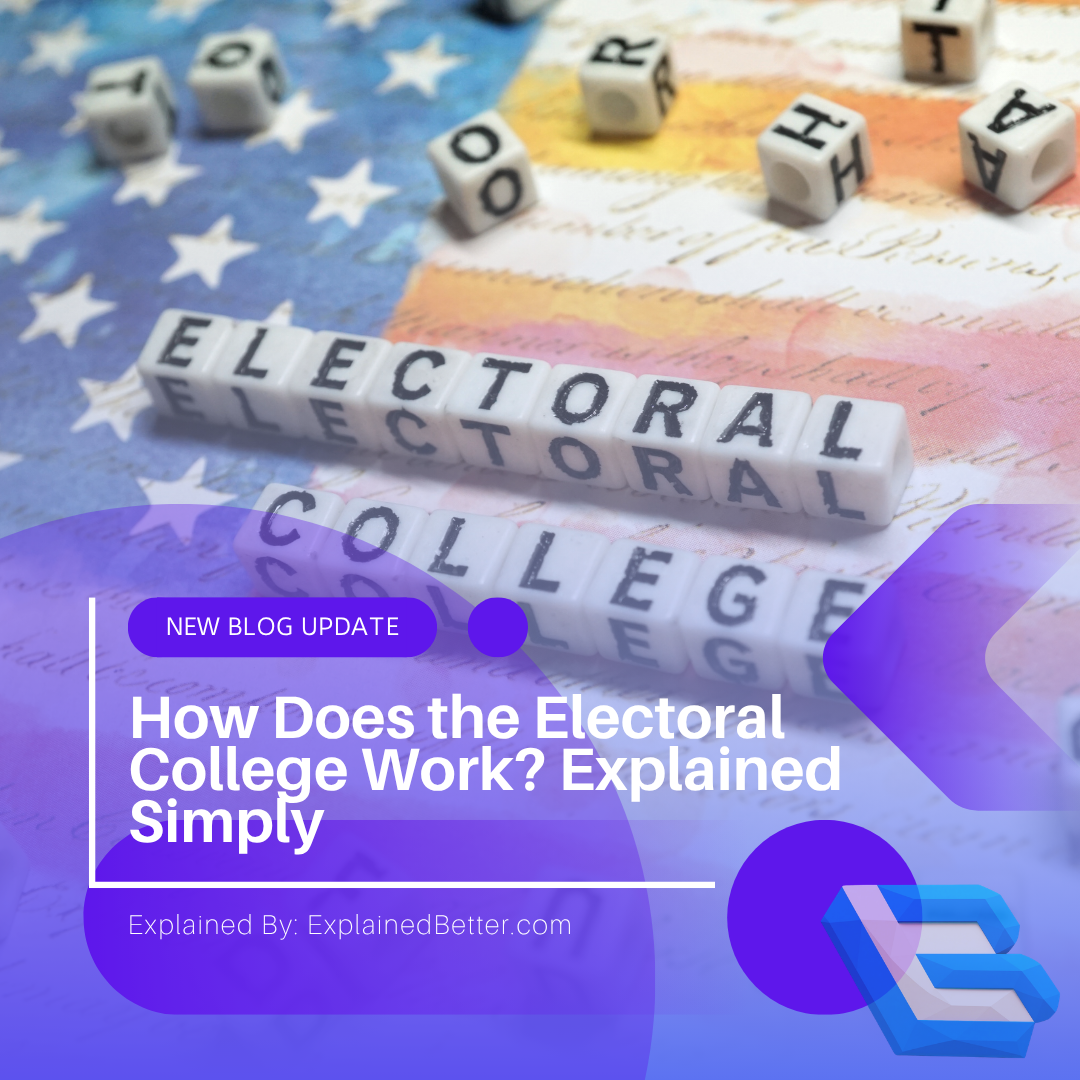

Americans don’t directly elect their president. That single fact surprises a lot of people and explains why a candidate can win the most votes nationwide and still lose. Here’s how the Electoral College actually works, why it exists, and the arguments on both sides — explained neutrally.
Key takeaways
- Voters technically choose “electors,” who then formally cast the votes that elect the president.
- There are 538 electoral votes; a candidate needs 270 to win.
- Most states award all their electoral votes to whoever wins that state — winner-take-all.
- This is why the national popular-vote winner can still lose the presidency.
The basic idea
When Americans vote for president, they aren’t directly choosing the president. They’re choosing a slate of electors pledged to a candidate. Those electors — collectively the Electoral College — then cast the votes that officially decide the outcome.
In practice electors almost always vote as pledged, so the result is known on election night. But the formal, constitutional act of electing the president happens weeks later when the electors meet. The popular vote in each state determines who those electors are.
How the numbers work
There are 538 electoral votes in total, and a candidate needs a majority — 270 — to win.
Each state’s number of electoral votes equals its representation in Congress: its number of House seats (based on population) plus its two Senators. So every state gets at least 3, no matter how small, while large states get many more. Washington, D.C. also receives 3.
That “plus two Senators” is important. Because every state gets two regardless of size, smaller states carry slightly more electoral weight per person than large ones — a deliberate feature that becomes central to the debate over the system.
Winner-take-all: the crucial rule
Here’s the mechanic that shapes American elections more than any other. In 48 of the 50 states, electoral votes are awarded winner-take-all: whoever wins the state’s popular vote, even by a single ballot, receives all of that state’s electoral votes.
Win California by a landslide or by one vote, and you get the same 54 electoral votes. The margin within a state doesn’t carry over. (Two states, Maine and Nebraska, split some of their votes by congressional district instead.)
Why the popular-vote winner can lose
This is the outcome that generates the most argument, and the mechanism is straightforward once winner-take-all is clear.
Because a state’s entire electoral haul goes to its winner regardless of margin, running up huge margins in states you already win adds nothing extra. A candidate can pile up millions of “wasted” surplus votes in populous strongholds while narrowly losing several competitive states — and lose the Electoral College despite winning more votes nationwide.
It’s uncommon but not merely theoretical: it has happened in multiple US elections, including in 2000 and 2016. Whether that’s a flaw or a feature is exactly what people disagree about.
Why it exists at all
The Electoral College was created by the framers of the Constitution in 1787 as a compromise, shaped by the concerns and constraints of the time.
- A compromise between Congress and the peopleSome framers wanted Congress to choose the president; others wanted a direct popular vote. The Electoral College was a middle path between the two.
- Balancing large and small statesSmaller states feared being dominated by larger ones. Tying electoral votes partly to equal Senate representation gave them proportionally more weight — echoing the broader small-state/large-state bargain of the Constitution.
- The practical limits of 1787With slow communication and no national parties, the framers doubted ordinary voters could reliably judge candidates from across a vast country, and saw electors as informed intermediaries.
- The legacy of slaveryHistorians note the system was also entangled with slavery: the “three-fifths” counting of enslaved people boosted the electoral weight of slaveholding states — an uncomfortable but well-documented part of its origins.
The debate today
The Electoral College is one of the most contested features of American government. Reasonable people disagree, and a neutral summary means laying out both sides.
Supporters argue it protects smaller states from being ignored, forces candidates to build geographically broad coalitions rather than focusing only on big cities, and provides clear state-by-state outcomes that can make disputes easier to contain.
Critics argue it violates the principle of one-person-one-vote by weighting votes unequally, lets the popular-vote loser win, and causes candidates to ignore most of the country in favour of a few swing states.
Changing it is difficult: amending the Constitution requires very broad supermajorities, and the states that benefit most have little incentive to agree. That’s a large part of why a system devised in the 18th century remains in place in the 21st.
The terms, explained
- Electoral College
- The group of electors who formally elect the US president, rather than a direct national vote.
- Elector
- A person chosen to cast an official electoral vote, pledged to a candidate based on their state’s popular vote.
- 270
- The majority of the 538 electoral votes needed to win the presidency.
- Winner-take-all
- The rule in 48 states awarding all electoral votes to the state’s popular-vote winner, regardless of margin.
- Swing state
- A competitive state whose outcome is uncertain and therefore decisive — where campaigns concentrate their effort.
- Popular vote
- The total number of individual votes cast nationwide, which does not directly determine the winner.
- Faithless elector
- An elector who votes against their pledge. Rare, and now restricted or penalised in many states.
For the maps and numbers behind these terms, our News video explainers cover how elections work in the same neutral, plain-English style.
Frequently asked questions
Why doesn’t the US just use the popular vote?
Because the Constitution established the Electoral College, and changing it would require a constitutional amendment needing very broad agreement — including from states that benefit under the current system. There are also genuine arguments on both sides about which method is better.
How can someone win the vote but lose the election?
Winner-take-all means large surplus margins in states you already win don’t help, while narrow losses in competitive states cost you all their electoral votes. A candidate can therefore lead nationally yet fall short of 270.
What are swing states?
Competitive states where neither party has a reliable lock, so their result is uncertain and decisive. Campaigns concentrate there because those are the votes most likely to change the outcome.
Can electors vote against how their state voted?
Historically a few “faithless electors” have, but it’s very rare and has never changed a result. Many states now legally bind electors to their pledge or penalise those who break it.
Sources & further reading
- U.S. National Archives — About the Electoral College
- USA.gov — The Electoral College
- Britannica — Electoral College