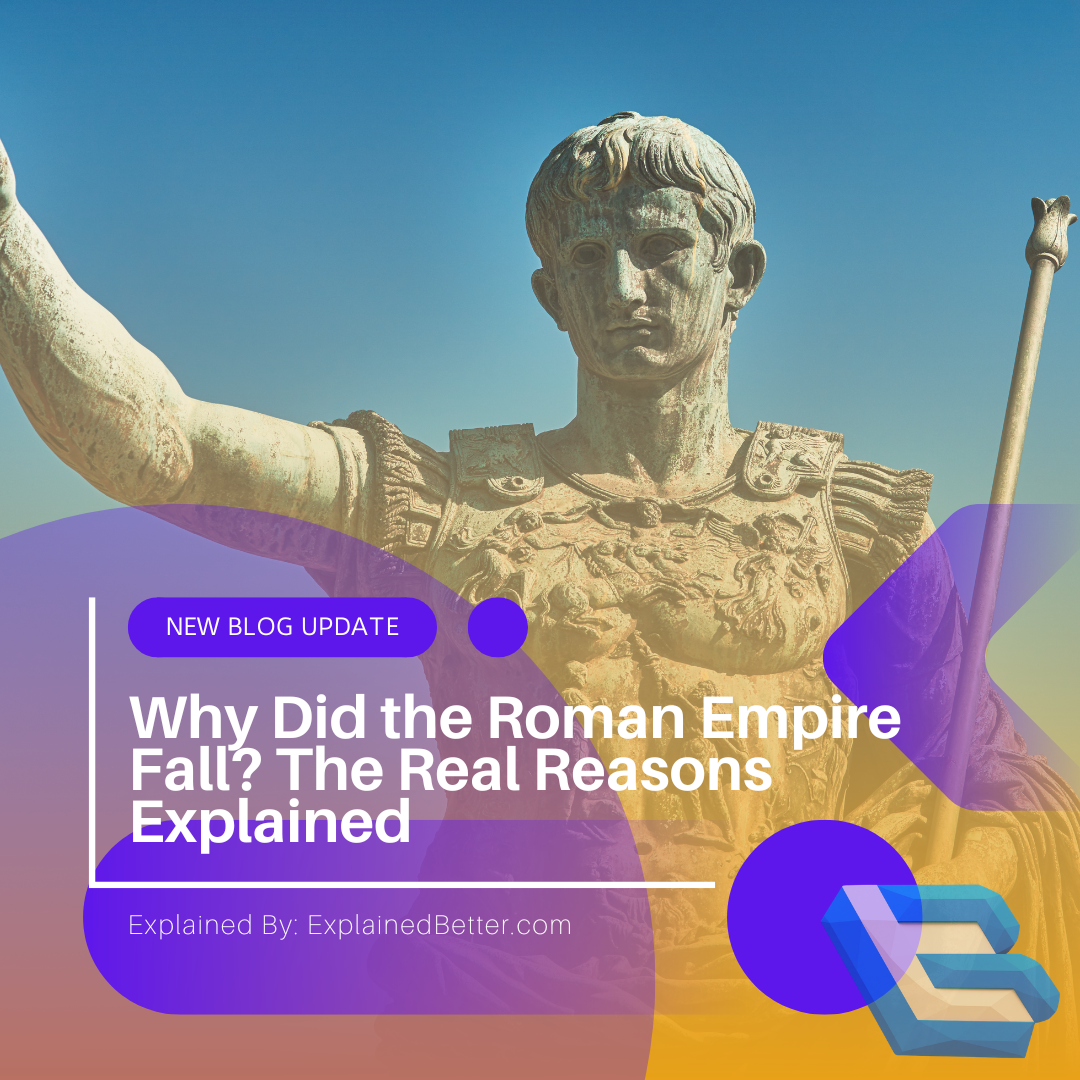

Rome didn’t fall in a day, and it didn’t fall for one reason. The popular image — barbarians pouring over the walls of a decadent city — is the least useful part of the story. Here’s what actually happened, and why historians still argue about it.
Key takeaways
- Only the Western Roman Empire fell in 476 AD. The Eastern half survived for almost another thousand years.
- There was no single cause — political instability, economic strain, military pressure and disease compounded over centuries.
- The “fall” was gradual. For many people, life changed slowly rather than collapsing overnight.
- Many historians now describe it as a transformation into the early medieval world, not a simple ending.
First: which Rome actually fell?
This is the detail that clears up most of the confusion. By the late 4th century the empire was administratively split into two halves, each with its own emperor and capital — the Western Roman Empire ruled from Italy, and the Eastern Roman Empire ruled from Constantinople.
When people say “Rome fell,” they mean the West. The East not only survived, it thrived for centuries — we now usually call it the Byzantine Empire, though its own people simply considered themselves Romans. It endured until Constantinople finally fell to the Ottomans in 1453, nearly a millennium after the West ended.
The traditional date — and why it’s debated
The conventional marker is 476 AD, when the Germanic commander Odoacer deposed the teenage emperor Romulus Augustulus and did not replace him. No new Western emperor was appointed, and the imperial office in the West simply ceased.
But that date is tidier than the reality. Odoacer still governed Italy using Roman administration, and many contemporaries didn’t experience 476 as an epochal rupture — it was one more turbulent year in a century full of them. Historians use the date as a convenient bookmark, not as the moment everything stopped.
The real causes, layered over centuries
Political instability
Rome never solved the problem of succession. Emperors were routinely installed and murdered by the army, and during the Crisis of the Third Century (roughly 235–284 AD) the empire churned through dozens of emperors and briefly fragmented into rival states. It recovered, but the pattern of civil war repeatedly diverted armies and resources inward at moments when they were needed on the frontier.
Economic strain and currency debasement
Maintaining a vast army and bureaucracy was ruinously expensive, and the empire’s expansion — a major historic source of wealth and slaves — had stopped. To cover the gap, emperors repeatedly reduced the silver content of coinage. The predictable result was inflation and eroding confidence in money, alongside heavy taxation that pressed hardest on the farmers and towns the system depended on.
Pressure on the frontiers
The frontier was never simply “barbarians versus Rome.” Germanic peoples had traded with, settled in and served in the Roman army for generations. What changed in the 4th and 5th centuries was scale and desperation: the westward movement of the Huns displaced groups like the Goths, pushing large populations into imperial territory under duress.
The empire’s response — sometimes settlement, sometimes war, often mismanagement — produced disasters like the Battle of Adrianople in 378 AD, where an emperor and much of the eastern field army were destroyed. Rome itself was sacked in 410 by the Visigoths and again in 455 by the Vandals; shocking symbolically, though by then the city was no longer the seat of power.
Disease
Major epidemics — the Antonine Plague in the 2nd century and the Plague of Cyprian in the 3rd — killed significant portions of the population. Fewer people meant fewer taxpayers, fewer farmers and fewer recruits, weakening the empire’s capacity to absorb later shocks.
Overextension and division
The empire was simply enormous, with communication limited to the speed of a horse or ship. Splitting the administration made governance more practical, but it also meant the wealthier, more urbanised East could — and eventually did — prioritise its own survival over rescuing the West.
What the “fall” actually meant for ordinary people
For most people there was no single day when Rome ended. Change arrived as a slow unravelling: long-distance trade contracted, coinage circulated less, cities shrank, large-scale construction stopped, and literacy narrowed toward the church and elites. Local strongmen replaced distant imperial authority.
This is why many historians now prefer transformation over collapse. Roman law, language, religion and administrative habits didn’t vanish — they were absorbed by the kingdoms that followed, shaping medieval Europe and, through it, the modern West. Something ended, but a great deal carried through.
The terms, explained
- Western Roman Empire
- The western half of the divided empire, governed from Italy. This is the half that ended in 476 AD.
- Byzantine Empire
- The modern name for the surviving Eastern Roman Empire, centred on Constantinople until 1453.
- Crisis of the Third Century
- A roughly 50-year stretch of civil war, invasion, plague and economic breakdown that the empire survived but never fully recovered from.
- Debasement
- Reducing the precious-metal content of coins while keeping their face value — an early form of inflationary money-printing.
- Late antiquity
- The period bridging the classical and medieval worlds, studied as an era of transformation rather than pure decline.
Frequently asked questions
What year did the Roman Empire fall?
476 AD is the conventional date for the Western Roman Empire, when Romulus Augustulus was deposed. The Eastern Roman (Byzantine) Empire continued until 1453.
Did barbarians destroy Rome?
Not in the simple sense. Germanic peoples had long traded with and served Rome, and many sought settlement rather than destruction. Their pressure was one factor among several — and it was most damaging because Rome was already weakened internally.
Did Christianity cause the fall?
Gibbon argued it contributed, but modern historians generally reject this as a primary cause. The Eastern Empire was at least as Christian and survived for another thousand years.
Could Rome have been saved?
Historians disagree, which is part of what makes the question durable. Some point to specific avoidable failures; others argue the structural pressures — fiscal, demographic and military — were too deep for any single leader to reverse.
Sources & further reading
- Britannica — The fall of the Western Empire
- The Met Museum — The Roman Empire
- BBC History — The Romans